|
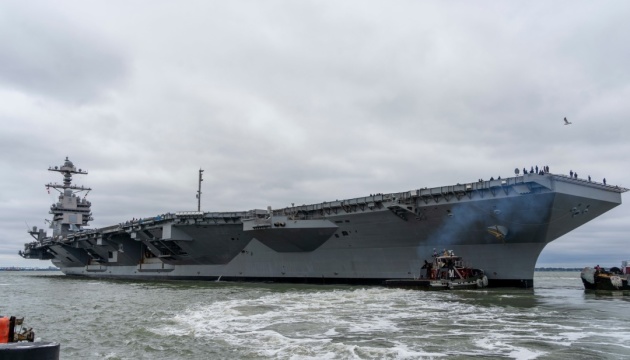
Last week, looking at the position of the USS Gerald R Ford – the most powerful aircraft carrier, indeed the most powerful warship of any kind in the world – I suggested that she would be in position to strike Iran yesterday. With the Ford having put into Souda Bay in Crete yesterday morning and the last of her escort destroyers, the USS Winston Churchill, passing Gibraltar on Sunday, this prediction has played out.
I also suggested that just because US strike ops could start immediately, it didn’t mean they necessarily would. The Ford and her strike group have averaged less than 18 knots across the Mediterranean and the carrier has now put in for stores and repairs: it is clear that the US Navy is not in a rush. Old pictures of the Ford fully lit just off Haifa captioned, “USS Ford strikes now imminent” are a good example of the misinformation surrounding this potential operation just now. If there is one thing I can promise the carrier isn’t doing right now it’s sitting just off the coast of Israel with all her upper deck lights on.
Air spotters have been even busier trying to keep on top of many flights in and out of the region with seemingly someone saying every hour “this aircraft in this position means strikes are about to commence”. As before, there is only one point at which we’ll know for sure when it’s starting, and that is just after it’s started.
There is still a remote possibility that nothing will actually kick off. Deploying and then withdrawing what is now probably the largest gathering of US military power since Gulf War II in 2003 without firing a shot seems unlikely, sure. But there is a key meeting expected on Thursday, at the Omani Embassy in Geneva. This is a continuation of US envoys Witkoff and Kushner’s recent meetings with Iran’s Foreign Minister Araghchi, International Atomic Energy Agency (IAEA) Director Grossi and Omani mediators. Halting of uranium enrichment, missile restrictions, sanctions relief, and IAEA inspections are all up for discussion. People familiar with the Iranian regime are not optimistic, but we are in strange times and, as ever, talking is better than not talking.
If negotiations fail, what next? President Trump has warned of “bad things” if Iran doesn’t offer any deal that is to his liking. He has previously tweeted “KEEP PROTESTING – TAKE OVER YOUR INSTITUTIONS. HELP IS ON THE WAY,” which suggests he would like to see regime change. Overt discussions about oil are as absent as they were in Venezuela before that raid back in January. Experience has shown it would be as well to remind everyone that thanks to fracking and related technologies, the US no longer needs foreign oil – though of course it might like to direct Iranian oil in a way that suits its purposes. A lot of people evidently didn’t get the fracking memo and think that the US is its old oil-hungry self.
I’m also struck by how many people still believe this could play out like the capture of Maduro. I can’t tell how likely it is that negotiations will succeed: I can say that the military situation with Iran is very, very different from that in Venezuela. I’m no spec-ops type, but missiles and air warfare was my old job, and I can talk about that.
For a start, the distances here are vastly different. Both the USS Ford in the Mediterranean and the USS Abraham Lincoln in the Gulf of Oman (GOO) are over 1,000 miles from Tehran. Even the remarkable V-22 Osprey tiltrotor can’t cover that sort of distance without (multiple) refuellings. It’s obviously possible to refuel Ospreys or various kinds of helicopter in the air, but you’re now talking about vulnerable tanker planes headed well into harm’s way. This being the US military there are theoretically other options: correctly equipped Ospreys can refuel other Ospreys in the air, and US Navy carrier fighters can also be equipped as aerial tankers. Nonetheless a major air tanking operation in hostile skies would be a big ask.
It might make more sense to stage out of a base ashore somewhere. One does note that the US special-ops community operated in some strength against Islamic State out of Harir airbase in northern Iraq, within Kurdish territory. Reportedly there are still some US personnel there, and the base is less than 400 miles from Tehran. Or the US could be even bolder and land forces at a temporary base within Iran itself – though that didn’t work out too well back in 1980 at “Desert One”.
Of course the fact that Harir is close to Iran cuts both ways: the Iranians could pummel it with a heavy missile bombardment if they chose, and it’s still a hugely greater distance to cover than Venezuela. Fuerte Tiuna where Maduro was seized is 11 miles from the coast.
Then there’s the matter of Iranian anti-air capability. The US (and Israel) showed last year that they can operate in Iranian airspace with impunity. This isn’t just a matter of stealth jets: non-stealthy aircraft were used also, and it was clear that more or less total Suppression of Enemy Air Defences (SEAD) had been achieved wherever it was required. Russian-supplied S-300 missile systems, and any other similar heavy AA missiles, had clearly been taken out of action – just as they were, apparently, in Venezuela. It wasn’t Delta Force that made the Venezuela operation possible: quite a few nations have special-ops troops in the same class as the Deltas. Very few nations have the air and electronic warfare capability to conduct SEAD and enable operations like the Venezuela one.
But there is a limit to SEAD. Big, truck-mounted missiles – and, even more so, the big radars they need to detect their targets – are relatively easy to locate and destroy. This was clearly done effectively last year and could be done again to permit US air operations over Iran in the near future.
But then there are man-portable, shoulder fired missiles like the Russian Verba (“Willow”, known to Nato as SA-29 “Gizmo”). These will fit in a cupboard or a car boot and there’s no realistic prospect of eliminating them from an area by air operations. They can be dangerous up to altitudes of 15,000 feet: most helicopters struggle to get above that with any heavy load aboard.
Recently, reports have emerged that Iran has signed a $500 million dollar deal with Russia for the Verba/SA-29. It’s not clear how many of these have been delivered yet but they are specifically designed to take out low-flying aircraft, cruise missiles and drones. Fixed-wing planes (or Ospreys in aeroplane mode) can easily fly too high for them, but they’re obviously a problem when coming in to land. It would be odd if there weren’t some SA-29s ready for use in the vicinity of, say, Iranian Supreme Leader Khamenei.
So we probably aren’t looking at any daring special ops raids here. Never say never: the US special forces have pulled off some amazing things in their time, but air landings near important Iranian targets would seem to cross the line from daring into foolhardy.
More realistic, I believe, will be US and Israeli intelligence cueing precision strikes against significant regime targets: commanders, senior mullahs and so on. The Israelis have already done this to remarkable effect and the regime still stands, but perhaps heavier US firepower can make the difference and bring down Iran’s power structures. Perhaps US and Israeli air strikes can blind, disable and disorientate Iran’s forces so badly as to cripple any possible retaliation. However, in line with their mobile and agile philosophy, the Revolutionary Guards have drilled many times how to operate without the Supreme Leader himself giving the orders. When we wargamed attacking Iran’s dispersed, mobile Guards and normal military, we used to liken it to punching fog – you can hit it as hard as you like, but it’s very difficult to damage it seriously. See the Houthis for a recent example. For Iran, scale this up by a hundred.
If the US can’t work some kind of magic, Iran will have options for retaliation. That’s just maths. Let’s say Iran goes all-in on the US Combined Air Operations Centre (CAOC) in Al Udeid – not a demonstration attack like last June, but all-in – and fires hundreds of missiles at it, perhaps in a single salvo. These weapons, many locally made rather than Russian, might not be very good: some will malfunction and some will just miss, but if the Iranians concentrate their efforts they can put more missiles on Al Udeid, or other bases in the region, than the US can realistically match with Patriot and Thaad defensive interceptors. At this point some missiles get through – resulting in US (and probably allied) fatalities. What then?
The Iranians will have a much harder time targeting US warships, even in the Gulf itself. A warship moves, and tracking a US warship that doesn’t want to be tracked isn’t simple. But if that warship isn’t under the protective envelope of a carrier-borne Hawkeye radar plane it needs to have its own radar on to protect itself. That means it can be tracked by Chinese satellites for certain, and maybe by Iranian electronic warfare units. If the Iranians manage to track a US warship – maybe by means as simple as shadowing it using apparently civilian watercraft – they could throw a huge swarm of missiles and drones at it, and even an Arleigh Burke class destroyer can run out of interceptors quite fast.
So let’s all wish “fair winds” (good fortune) to the allied warships still in the Gulf today, including the Royal Navy minehunter HMS Middleton. This could get tense very quickly for them.
We don’t need to worry about the carriers Ford and Lincoln outside the Gulf overmuch, despite the usual “carrier killer” hype. They will operate with E-2 Hawkeye radar planes aloft around the clock, able to sweep the seas and skies for hundreds of miles – even in the case of low-flying, sea skimming threats. With the ships’ own radars switched off, finding them will be all but impossible. US carrier fighters, or land-based ones, will destroy any Iranian aircraft or vessel which might locate a carrier well before it can do so thanks to the inescapable curvature of the Earth. Many US fighters are now equipped with cheap, numerous missiles suitable for knocking down drone swarms: there are loadouts which let a fighter shoot down 50 drones in one mission before even switching to guns. If somehow a threat leaks through the air screen, the carrier’s escorting warships can fire their missiles using Hawkeye targeting data, or briefly use their own radar if necessary.
Nonetheless it’s quite possible that the US will punch the smoke and the mullahs’ regime will still stand. Worse, US bases and even some US ships in the region may see their defences overwhelmed and take some nasty hits in return. And what can the US do then? It will have fired off billions of dollars of munitions and maybe spilled American blood, perhaps to achieve very little.
So we wait for Thursday knowing two things. First, surprise is a major factor in war (for both sides), and any timeline or prediction (including mine) should be treated accordingly. Second, this is not Gulf War 1, Venezuela or a video game. Discombobulators don’t exist in real life. Overwhelming electronic warfare measures do, but might not always work against a country that has done nothing but prepare for this moment for many decades. This is the reason 30 per cent of the active US Navy and perhaps even more of the US Air Force are now in place awaiting further orders. It’s also the reason no one is in a hurry to kick off just yet.
|